
Cleaning Tips · 7 min read
Should You Clean or Regrout Your Tile?
A practical guide to checking whether compatible tile and intact grout may benefit from cleaning, or whether damage calls for regrouting or replacement.
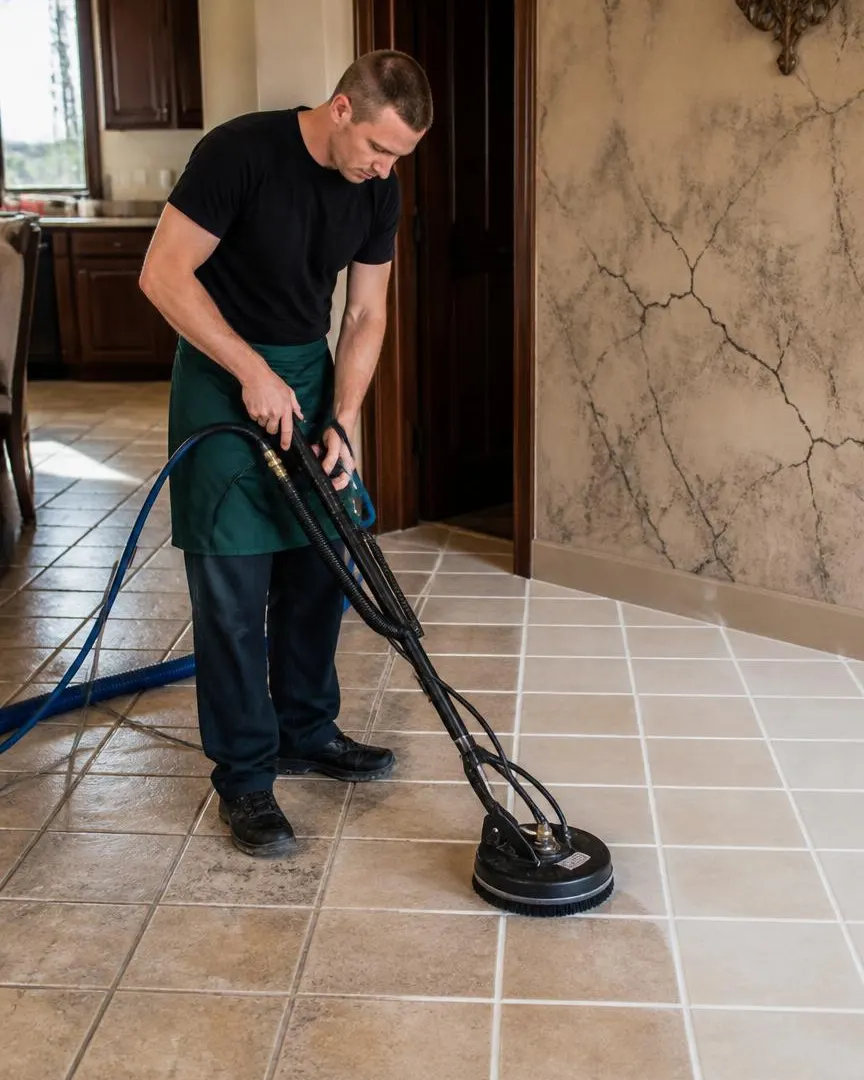
Inspect first. Compatible tile and intact grout may benefit from professional cleaning, but discoloration can also be permanent or connected to coatings, moisture, etching, or material damage. Regrout when grout is cracked, crumbling, or missing; replace tile when the tile or substrate has failed.
That order matters because the three options differ in cost and disruption. Cleaning is the least invasive first step when the material and grout are compatible, but it cannot repair damage or guarantee the original color.
How do you tell dirty grout from damaged grout?
Run these five checks before you call anyone. They take about ten minutes and will point you at the right answer.
- Look for uniformity. Grout that has darkened evenly across a whole floor is soiled. Grout that is fine in one area and destroyed in another usually has a moisture or movement problem behind it.
- Press it with a fingernail. Sound grout is hard. If it crumbles, dents, or sheds sandy grit, it is failing and cleaning will not bring it back.
- Check for gaps and cracks. Missing sections, hairline cracks running along a line, or grout that has pulled away from tile edges are all regrout signals.
- Test one small area. Clean a hidden square with a suitable product, a soft-to-moderate brush, and the label's dwell time. A change can show that some removable soil is present, but a spot test cannot predict the final color of the whole installation.
- Look at the tile, not just the grout. Cracked, drummy, or loose tiles are a different problem entirely — that is a replacement conversation, not a cleaning one.
If the material is compatible, the grout is intact, and a spot test shows removable soil, professional cleaning may be appropriate. Permanent discoloration, etching, coatings, or moisture-related changes can remain.
What did a real Orange County grout-cleaning job involve?
A published customer review describes one tile-and-grout cleaning job step by step. That documented result is an example, not a guarantee for every surface.
"worked with a power brush to lift off years of buildup and accumulated discoloration that no DIY can achieve"
— Firas Naji, Google review
Three distinct things happened on that job. First, chemistry: the review says the work began with a deep pre-treatment for the grout stains. On a compatible surface, a suitable product and dwell time may help release accessible soil; permanent discoloration and damage can remain. We explain the product-selection principle in what cleaning-product labels actually tell you.
Second, mechanical agitation — the power brush described in the review. On compatible tile and intact grout, appropriate chemistry, agitation, and extraction can remove accessible soil that surface wiping leaves behind. They cannot repair grout or guarantee its original color.
Third, containment. The reviewer wrote that the workers were "careful about protecting the baseboards, walls, and furniture from water damage". That is a historical customer description of one job, not a promise that every tile installation accepts the same process.
Another published review makes the method plainer: Firas Naji wrote on Google that the crew "worked with a power brush to lift off years of buildup and accumulated discoloration that no DIY can achieve".
Clean vs. regrout vs. replace: the comparison
| Professional cleaning | Regrouting | Replacement | |
|---|---|---|---|
| Best when | Common ceramic or porcelain tile is compatible, grout is intact, and accessible soil is present | Grout is cracked, crumbling, or missing | Tiles are broken, loose, or the substrate has failed |
| What it involves | Material check, suitable pre-treatment, agitation and extraction; optional sealing may be quoted separately | Removing old grout and packing new grout in | Tearing out tile and often the underlayment |
| Improves color? | Often, when removable soil is responsible; permanent discoloration may remain | Replaces the grout material | Replaces the tile |
| Fixes structure? | No | Yes, at the grout line | Yes, everything |
| Disruption | Lowest — one visit | Moderate — dusty, room out of use | Highest — full renovation |
| Who does it | Specialty technician, after accepting the surface | Tile installer or handyman | Tile installer / contractor |
| How it is priced | Quoted after the material, area and condition are checked | Not a service we offer | Not a service we offer |
| When to consider it | Compatible material, intact grout and accessible soil | Failed grout | Failed tile or substrate |
The practical rule: confirm the material and condition first. Cleaning may be a sensible lower-disruption option for compatible tile and intact grout; failed grout, loose tile, active moisture, and structural damage need another trade.
When is regrouting genuinely the right call?
Regrout when the grout has physically failed, not merely stained. That means crumbling, powdering, cracked lines, or sections that have fallen out entirely.
The tell is usually recurring moisture. If grout keeps failing in the same spot — a shower floor corner, the base of a wall — something behind it is wet, and new grout over a wet substrate fails again.
Regrouting is a tile trade, not a cleaning trade. Art's Cleaning Services does not regrout or replace tile; we will tell you plainly when that is what you are looking at rather than sell you a clean that cannot fix it.
When does the tile itself need replacing?
Replace when the tile or what is under it has gone, not when it looks tired. Cracked tiles, tiles that sound hollow when tapped, or tiles lifting at a corner all point at a failed substrate or adhesive.
Water damage is the usual driver in bathrooms. Once moisture has reached the backer board, cleaning and regrouting are both cosmetic fixes on a structural problem.
If you are mid-renovation and the tile is staying, the useful service is post-construction cleaning — fine build dust settles into fresh grout lines and needs extracting before it sets.
Should you seal grout after cleaning?
Only when the material, grout condition, and sealer are compatible. Sealing is optional, is quoted separately, and is not appropriate for every installation. Natural stone first requires positive identification and acceptance for the proposed products and method.
We will tell you whether sealing makes sense for your specific surfaces during a tile and grout cleaning visit. Not every floor needs it, and it is not worth doing on grout that is about to be replaced.
Why does grout darken so quickly in Orange County?
Hard water is the main culprit here. Mineral-rich water dries on shower walls and floors, leaving scale that grips soap residue and traps everything else against the grout.
That is why bathrooms in Irvine — including the 92602 and 92618 areas — Orange, and Mission Viejo show grout discoloration faster than the same tile would in a soft-water region. We cover the chemistry of it in hard water stains in Orange County bathrooms.
Bathrooms are also 12 of the 50 points on our 50-point deep-clean checklist, alongside 12 kitchen, 12 living area, 6 bedroom, and 8 whole-house tasks — but routine bathroom cleaning is different from separately scoped tile and grout cleaning.
What should you do first?
Start with a material and condition check. If the tile is compatible and the grout is intact, cleaning can be quoted; if the surface is damaged or moisture is active, repair or remediation comes first.
Art's Cleaning Services has cleaned 5,000+ homes since 2021 and holds 850+ five-star reviews at a 4.9 rating. Tile-and-grout work is quoted after a specialty technician checks the material, grout condition, size and access; there is no single price band shared with carpet, upholstery or other specialty services. Every visit carries a 100% satisfaction promise, and we reply as soon as possible during business hours.
If the inspection shows failed grout, loose tile, active moisture or incompatible material, cleaning is not the repair. More published examples of past cleaning work are in what real cleaning jobs look like.
Get a price for your home
Want this handled instead of scheduled?
Tell us the home size and the service you want. We reply as soon as possible during business hours with an upfront price — no walkthrough required for most homes.
Written by Art
Founder of Art's Cleaning Services, 5,000+ homes cleaned across Orange County since 2021.