
Local Guide · 7 min read
Why Do Orange County Bathrooms Get Hard Water Stains?
Hard water leaves dissolved minerals behind every time a drop dries. Here is why Orange County bathrooms scale so fast, how to manage recent film, and when permanent damage may remain.
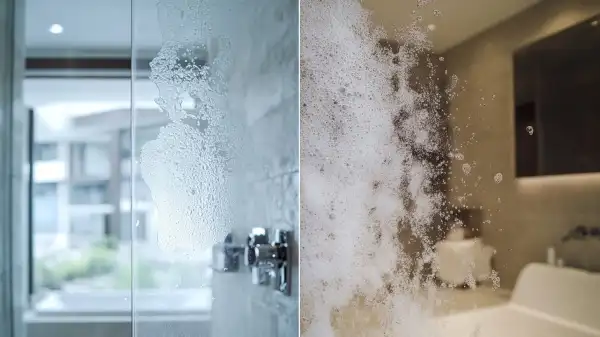
Orange County bathrooms scale because the local tap water is hard: it carries dissolved minerals that stay behind whenever a droplet evaporates. The white film on your shower glass is that residue, not dirt, which is why scrubbing harder does not shift it. Our 50-Point deep clean dedicates 12 of its 50 tasks to bathrooms for exactly this reason.
What actually causes the white film on shower glass?
Mineral deposits, left by water that evaporated rather than being wiped away. Water carries dissolved minerals; the water leaves, the minerals do not. Each shower adds another microscopic layer on the glass, the chrome, and the tile.
This is why the film behaves unlike ordinary grime. Soap and a cloth remove dirt sitting on a surface, but mineral scale bonds to it. Removing it needs a product that dissolves the deposit, plus dwell time to work — not more pressure.
Hard water is one of the four cleaning challenges we call out on our Irvine service area page, alongside construction dust, pollen, and HOA standards. It affects every Orange County city we serve, from 92618 in Irvine to coastal Newport Beach 92660.
Where does hard water damage show up first?
| Surface | What you see | Why it happens there |
|---|---|---|
| Shower glass | Cloudy white haze that returns days after cleaning | Constant wetting and drying, with no wiping between |
| Chrome fixtures | Crusty rings at the base of taps and around the shower head | Water pools and evaporates in the same spots daily |
| Tile grout | Grey, darkened lines that mopping never brightens | Grout is porous, so scale and soap scum absorb into it |
| Toilet bowl | A ring at the waterline | The water level sits still and evaporates at that exact height |
| Glassware and mirrors | Spotting after air-drying | Droplets dry in place instead of being wiped off |
Grout is the one that becomes permanent-looking. Tile itself resists staining, but grout absorbs mineral scale, soap scum, and mildew, which is why floors keep looking dull no matter how carefully you mop.
How do you remove hard water stains properly?
The sequence matters more than the product. Work in this order:
- Ventilate the bathroom and put on gloves. Never mix a descaling product with bleach or with another cleaner — combining them is genuinely dangerous.
- Apply a descaling product made for mineral deposits. These work by dissolving the deposit chemically; abrasive pads mostly scratch the glass.
- Let it dwell. This is the step almost everyone skips. Give the product the time its label specifies before touching anything.
- Agitate gently with a non-scratch pad, then reapply to any area that is still hazy rather than pressing harder.
- Rinse thoroughly and dry the surface completely. If you let the rinse water air-dry, you have just started the next layer of scale.
- Polish chrome dry. Our checklist specifies chrome fixtures polished dry for this reason — a wet fixture spots within hours.
If two careful rounds do not improve it, stop before damaging the finish. The haze may be bonded scale, etching, a coating issue, or another permanent change; that is the point to identify the surface and assess whether professional cleaning is compatible.
When is it beyond DIY?
When the scale has been building for years, or when the problem appears to be in grout rather than on glass. Household descalers may help recent compatible surface film, but older discoloration can be permanent or tied to moisture, coatings, etching, or material damage.
This is where separately scoped tile and grout cleaning may fit rather than a house clean. A specialty technician first checks the material and condition; the usual eligible scope is common compatible ceramic or porcelain tile with intact grout. Suitable chemistry, agitation, and extraction can remove accessible soil, but cleaning does not repair grout or guarantee the original color. Natural stone requires positive identification and acceptance before any method is chosen. Sherelle R. described one past result on Thumbtack:
"worked with a power brush to lift off years of buildup and accumulated discoloration that no DIY can achieve"
Firas Naji's Google review describes the method on one historical tile-and-grout cleaning job: the review says our team "worked with a power brush to lift off years of buildup and accumulated discoloration that no DIY can achieve" after a deep grout pre-treatment, and were "careful about protecting the baseboards, walls, and furniture from water damage". Those are the customer's words about that installation, not a result guarantee for another surface.
Hard water removal: DIY versus professional
| DIY descaling | Deep clean | Tile and grout cleaning | |
|---|---|---|---|
| Best for | Recent film on glass and chrome | Whole-bathroom buildup across surfaces | Grout that has gone grey or dark |
| Method | Household descaler and dwell time | 12 bathroom checklist tasks including descaling and mildew treatment | Pre-treatment, power brush, and extraction |
| Pricing | Cost of the product | $200–$400 ($250–$450 in Irvine) | Quoted after material, area and condition are checked |
| Realistic outcome | May clear recent compatible surface film | Improves the confirmed deep-clean scope | Can remove accessible soil; permanent discoloration may remain |
What does a deep clean do about hard water?
Twelve of the 50 points target bathrooms specifically, and several are aimed straight at mineral buildup. The checklist covers grout scrubbed with mildew and mould treated, shower glass left streak-free inside and out, and chrome fixtures polished dry rather than left to air-dry.
That combination is why a deep clean resets a bathroom in a way a maintenance visit cannot. Standard cleaning wipes the tub and shower; it is not scoped to descale them. The full task-by-task comparison shows where the line falls.
Our teams bring ordinary professional cleaning and descaling products selected for the identified surface and used according to their labels, so nothing needs to be supplied by you. Tell us before the visit about product or fragrance preferences and keep children and pets away from active work areas and wet surfaces.
How do you stop hard water stains coming back?
You cannot change the water, but you can stop it drying in place. Three habits do most of the work:
- Squeegee the shower glass after every use. A quick wipe prevents the layer that would otherwise need a descaler and dwell time later.
- Dry chrome fixtures after cleaning them. A wet tap spots as it dries, undoing the work you just did.
- Run the extractor fan during and after showering. Lower humidity means faster drying and less mildew in the grout.
Beyond that, frequency helps limit accumulation. Recent deposits are often easier to address than long-neglected buildup, but product compatibility and the underlying finish still matter. A recurring cleaning rhythm can reduce surface buildup, and our guide on how often to schedule a house cleaning helps you pick one.
Are some Orange County homes affected more than others?
Yes, and the difference is mostly humidity and fixture type. Coastal and lakeside homes in Huntington Beach and Newport Beach hold moisture longer, so mildew compounds the mineral problem in grout and around seals. Bathrooms with poor ventilation get the same effect anywhere.
Premium glass and polished chrome also show scale far more readily than older, textured finishes — a common pattern in Irvine's newer builds. It is not that those homes get more scale; it is that every layer is visible.
For the local seasonal rhythm, our guide on how often to deep clean an Irvine home explains when to schedule the reset. We have cleaned 5,000+ homes since 2021 and hold a 4.9 rating from 850+ five-star reviews, including 107 on Thumbtack, where much of our tile and grout work is reviewed.
Get a price for your home
Want this handled instead of scheduled?
Tell us the home size and the service you want. We reply as soon as possible during business hours with an upfront price — no walkthrough required for most homes.
Written by Art
Founder of Art's Cleaning Services, 5,000+ homes cleaned across Orange County since 2021.